

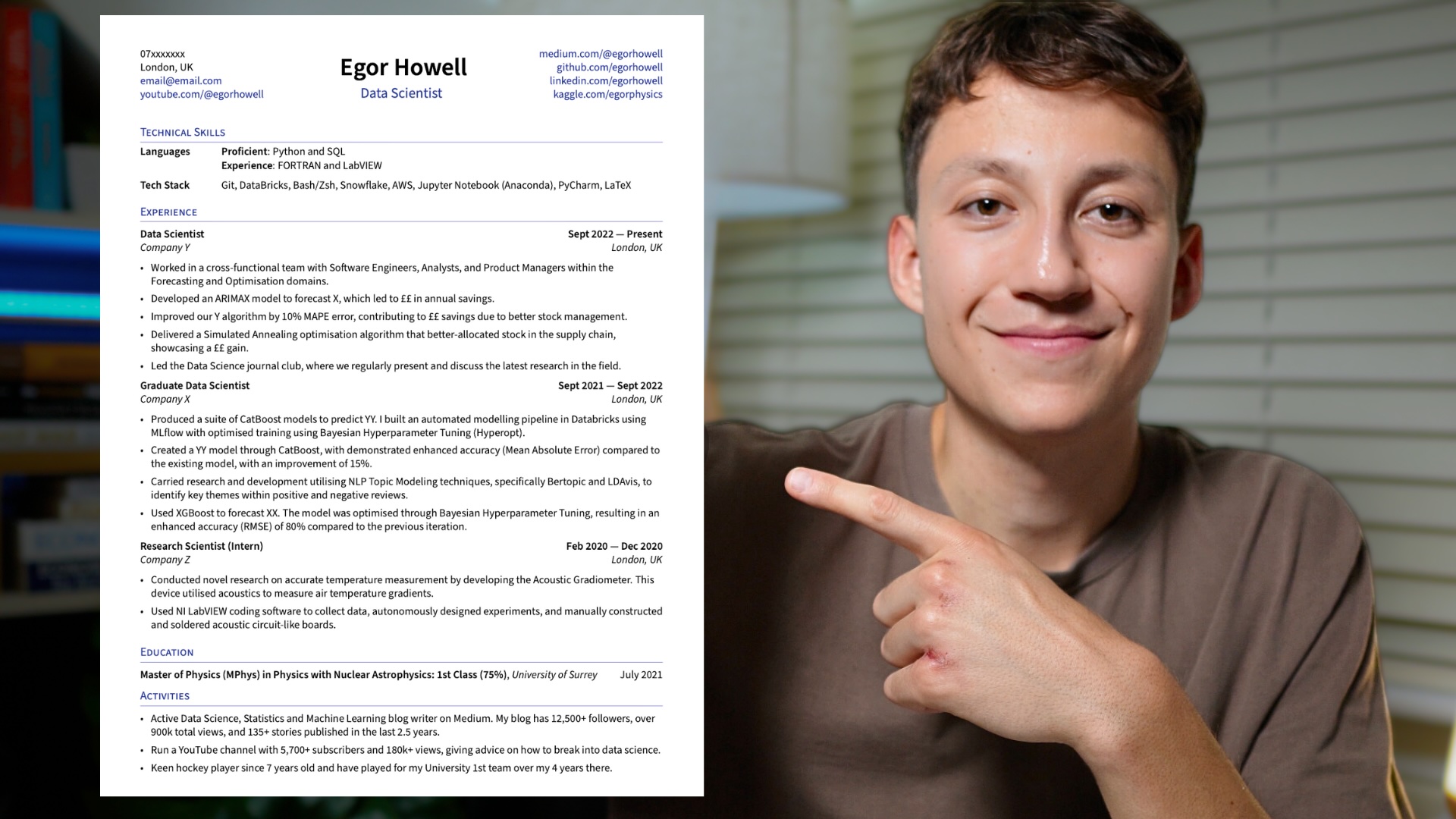
Most data scientist resume examples look the same: a skills section listing Python, R, SQL, and TensorFlow, followed by work experience full of “Responsible for” or “Worked on.” Because hiring managers have read this document thousands of times, it fails to stand out. To get noticed, you need to move beyond the generic template and highlight impact over mere tasks.
A strong data scientist resume leads with quantified impact, not tools. It shows what you built, what changed because of it, and what scale it operated at. The structure that consistently performs best: a brief professional summary (2-3 lines), skills section, experience section with bullet points in STAR format with metrics, a projects section, and education last (unless you are a recent graduate). Keep it to one page for under 5 years of experience; two pages is acceptable beyond that.
What Hiring Managers Actually Look For
| Priority | What They Want to See | Where to Show It |
|---|---|---|
| Technical depth | Specific tools and methods used in real contexts – not just listed | Experience bullets, projects section |
| Business impact | Numbers: revenue influenced, cost saved, accuracy improved, users affected | Every experience bullet |
| Problem-solving approach | Evidence of thinking through ambiguous problems, not just executing instructions | Summary, experience narratives |
| Communication ability | Resume itself demonstrates this – clarity, conciseness, no jargon for jargon’s sake | Entire document |
| Relevant domain experience | Industry match where possible (fintech, healthcare, e-commerce) | Experience section, summary |
| Production ML experience | Deployed models > notebook experiments – show what went live | Projects and experience |
Resume Structure: Section by Section
- Professional Summary (2-3 lines): who you are, your level of experience, and one or two distinctive strengths. Write it last – it is easier once the rest is done.
- Technical Skills: organised by category (Languages, ML Frameworks, Data Tools, Cloud/Infrastructure, Visualisation). Do not list things you cannot answer interview questions about.
- Work Experience: reverse chronological. 3-5 bullets per role. Metrics in every bullet where possible. Start each bullet with a strong action verb.
- Projects: 2-4 projects with GitHub links if available. Describe the problem, your approach, the outcome. This section matters more than most people realise.
- Education: degree, institution, graduation year. Relevant coursework or GPA only if it is genuinely strong (3.7+). Certifications here or in a separate line.
Skills Section: What to Include and What to Drop
| Include | Remove / Reconsider |
|---|---|
| Python (specify key libraries: pandas, scikit-learn, PyTorch) | Microsoft Office / Excel (implied) |
| SQL – specify dialects if relevant (PostgreSQL, BigQuery, Spark SQL) | R (include only if actively used – Python has largely replaced it) |
| ML frameworks: PyTorch, TensorFlow, Hugging Face | Tableau / Power BI (only if data viz is a core part of the role) |
| Cloud platforms: AWS (SageMaker), GCP (Vertex AI), Azure ML | Generic terms like ‘data analysis’, ‘machine learning’ without specifics |
| MLOps tools: MLflow, Kubeflow, Weights & Biases – if you have used them | Skills you learned in a single tutorial and have not applied since |
| Version control: Git, GitHub/GitLab | Long list of tools without context – length signals desperation |
How to Write the Experience Section
The STAR format (Situation, Task, Action, Result) is the backbone of effective resume bullets – but compress it to a single punchy sentence that leads with the action and ends with the result. The situation is usually implied by the company context.
The most important habit: every bullet should answer ‘so what?’ If you cannot add a number, add a scope indicator (team size, data scale, user count) or a qualitative outcome (reduced manual review process, enabled self-serve reporting for non-technical stakeholders).
Weak vs. Strong Resume Bullets
| Weak Bullet | Strong Rewrite | What Changed |
|---|---|---|
| Worked on customer churn prediction model | Built gradient boosting churn model (XGBoost) achieving 87% AUC, deployed to production serving 2M+ customer accounts | Added method, metric, and scale |
| Responsible for data cleaning and EDA | Designed and automated data pipeline (Python + Airflow) reducing preprocessing time by 60%, enabling daily model retraining | Quantified impact, showed ownership |
| Used NLP techniques to analyse text data | Applied BERT fine-tuning to classify 500K+ support tickets, reducing manual triage time by 40% and improving routing accuracy to 91% | Method + data scale + business impact |
| Created dashboards for the business team | Built self-serve analytics dashboards (Looker) used weekly by 120+ non-technical stakeholders, eliminating 15hrs/week of ad-hoc reporting | Users, frequency, time saved |
| Helped improve recommendation system | Contributed A/B tested collaborative filtering improvements that increased click-through rate by 12% (p<0.01, n=2.3M users) | Test rigour, metric, sample size |
Projects Section: Often Missing, Always Valuable
If you are a recent graduate, early-career, or transitioning into data science, the projects section can carry as much weight as the experience section – sometimes more. Hiring managers understand that entry-level candidates may not have production ML work; they use the projects section to assess how you think.
- Include a GitHub link – not just a description. A recruiter who can read your code sees your actual approach, not your self-description of it.
- Describe the problem first, not the tools. ‘Built a fraud detection model using XGBoost’ is less compelling than ‘Identified a 15% false positive rate in existing fraud rules and built an ML model reducing it to 3% on a synthetic dataset’.
- Demonstrate the full pipeline: data collection or sourcing, processing, modelling, evaluation, and ideally deployment or a clear deployment plan.
- Two to four projects is enough. Ten projects suggests you are padding; two well-described projects is stronger than eight vague ones.
ATS Optimisation: Keywords That Matter
Most large employers use Applicant Tracking Systems (ATS) to filter resumes before a human sees them. The system looks for keyword matches against the job description. This does not mean keyword stuffing – it means making sure you use the same terminology the job description uses.
- Mirror the job description language: if they say ‘machine learning models’, use that phrase – not ‘ML models’ or ‘predictive algorithms’
- Spell out acronyms at least once: ‘Natural Language Processing (NLP)’ – ATS systems may not match abbreviated forms
- Skills in a dedicated section rank better than skills buried only in paragraph text
- Avoid tables, columns, text boxes, or headers/footers in your resume – many ATS systems fail to parse these correctly
Common Mistakes That Cost You Interviews
- Objective statement instead of professional summary – ‘Seeking a challenging role…’ tells the reader nothing useful about you
- Education at the top for experienced candidates – unless you are a recent graduate, experience comes first
- No projects section – especially damaging for candidates with less than 3 years of experience
- Inconsistent tense – past tense for past roles, present tense for current roles, consistently throughout
- Generic skills list – listing Python is expected; listing ‘Python (scikit-learn, pandas, PySpark, FastAPI)’ is information
- PDF formatting issues – always submit as PDF unless instructed otherwise, and check it opens correctly from the recipient’s perspective
Final Checklist Before You Submit
| Check | Done? |
|---|---|
| Every experience bullet has at least one metric or quantified scope indicator | ☐ |
| Skills section is organised by category, not a flat list | ☐ |
| Projects section includes GitHub link (or live demo) and describes problem → outcome | ☐ |
| Tailored the resume to this specific job description’s language | ☐ |
| No generic phrases: ‘team player’, ‘self-starter’, ‘passionate about data’ | ☐ |
| Saved as PDF, tested that it opens correctly and ATS-parses cleanly | ☐ |
| Contact info includes LinkedIn and GitHub profile links | ☐ |
| Professional summary (2-3 lines) written and specific to your profile | ☐ |
A data science resume does one job: give a hiring manager enough specific evidence, in a short enough document, to justify a 30-minute call. Every word on the page should earn its place. The ones that do not are the ones that get cut – and the resume gets stronger each time.
